
Wood Carving
Wood Carving
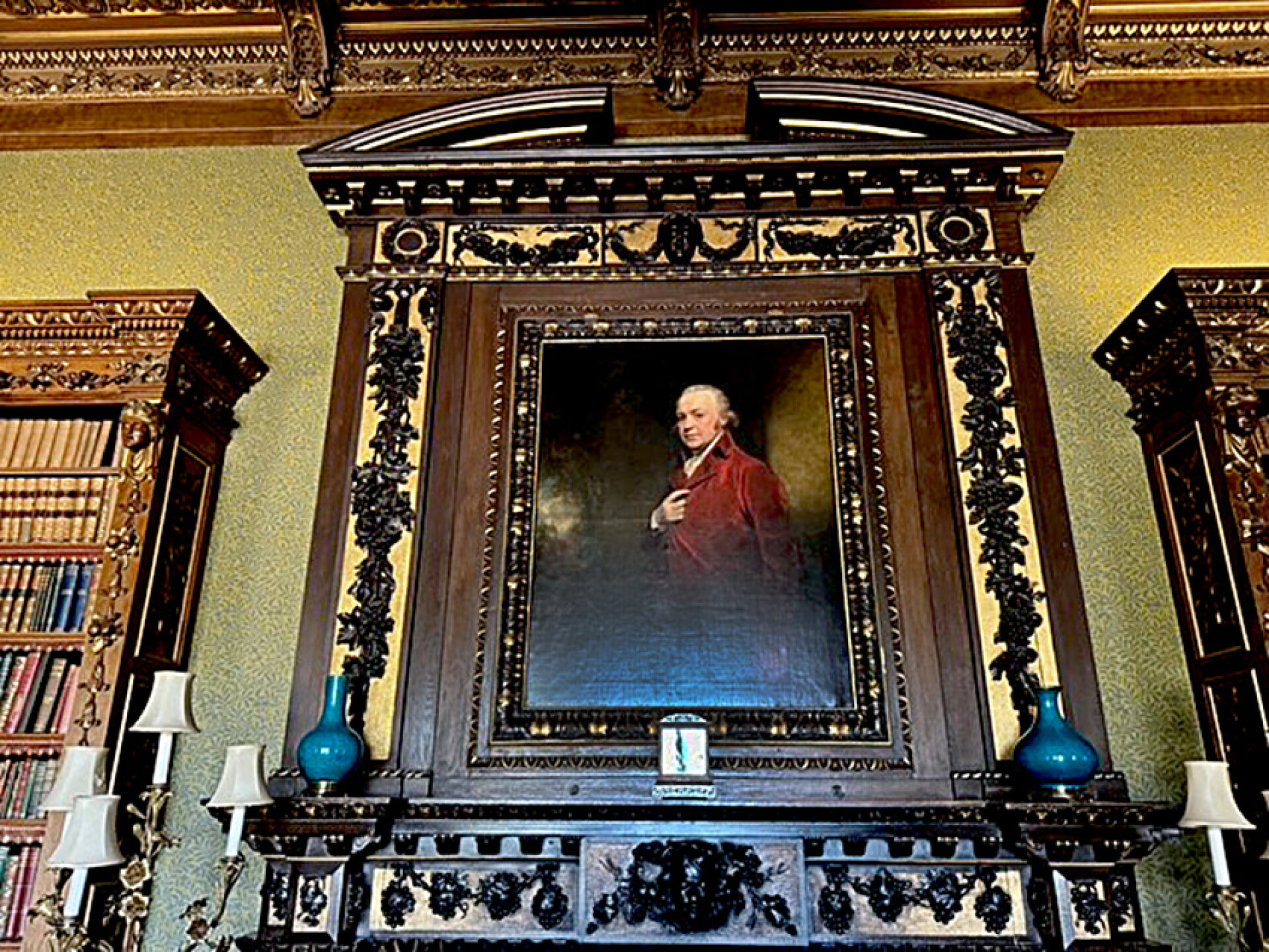
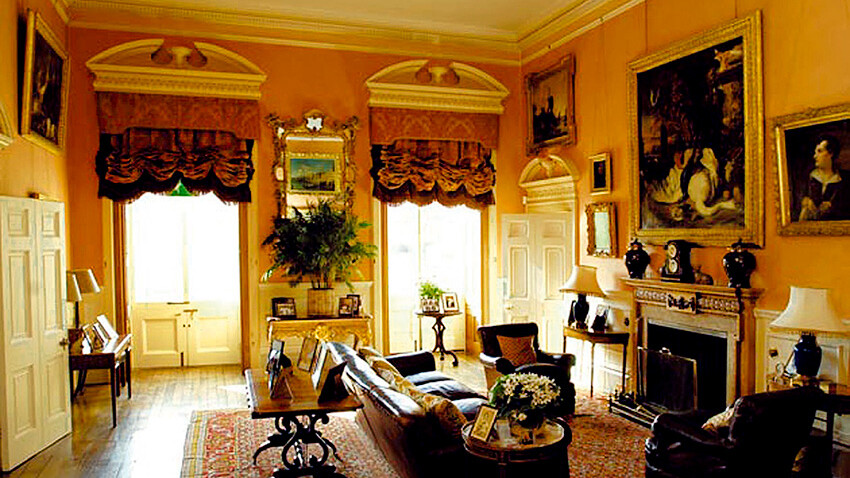
There are two paintings of Colonel Henry Herbert in the Castle. The first is in the library above the fireplace and depicts him before he was ennobled. It is possibly by Gainsborough but we can’t be certain. The second is also above a fireplace but this time in the Dining Room. It is larger and was painted to mark the honour of his ennoblement by King George III. This picture was definitely partly painted by Gainsborough but was finished by an American portrait artist, Gilbert Stuart.
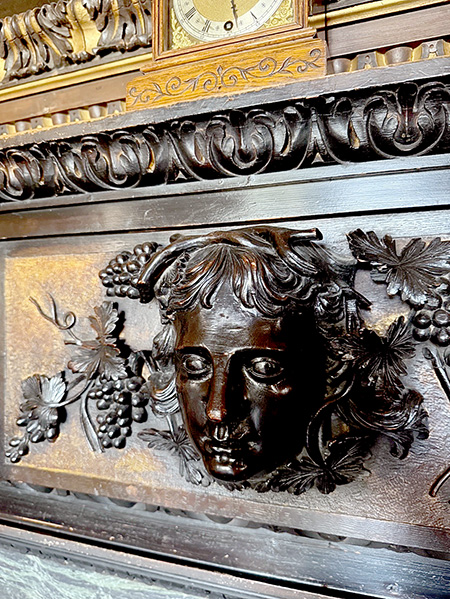
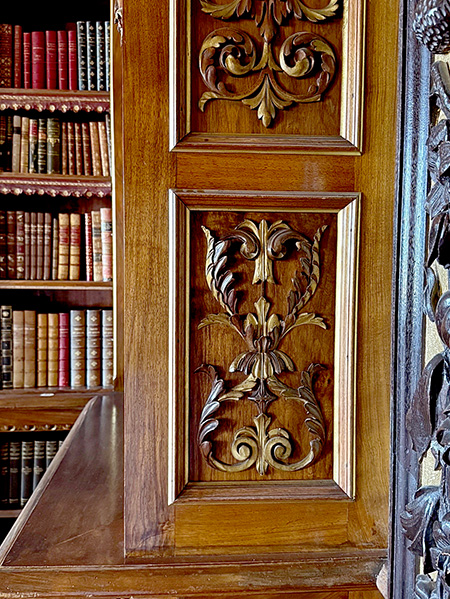
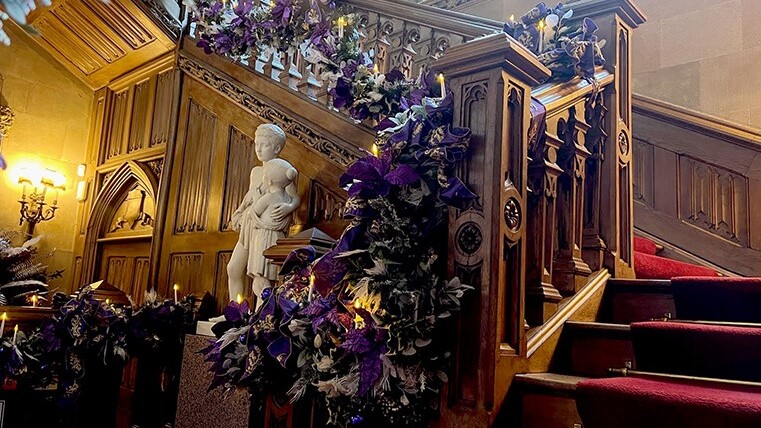
Apart from the character of the man represented, what is perhaps most striking about these paintings are the beautiful, intricately carved wooden frames in which both are set. The carvings are three dimensional and sculptural which gives increased depth to the paintings. They are quite beautiful although I am not sure of their provenance.
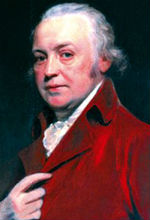
Col Henry Herbert, the 1st Earl of Carnarvon, lived during the time of both the American Wars of Independence and the French Revolution. After Napoleon came to power, England was cut off from Europe and so this period was a time which celebrated English nature, the flowers, fruit, leaves and so on. These carved frames both adorned the house and reflected the legacy of Grinling Gibbons.
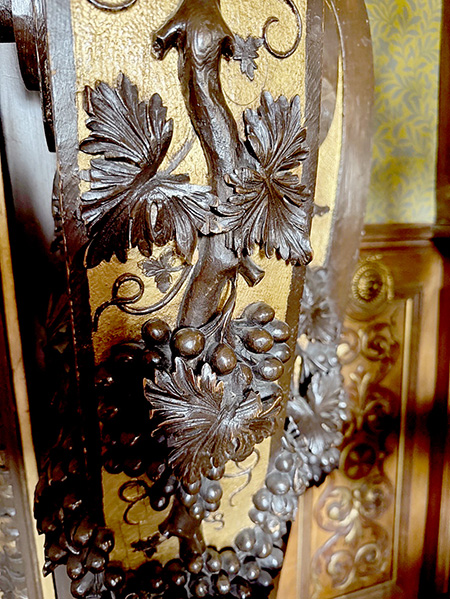
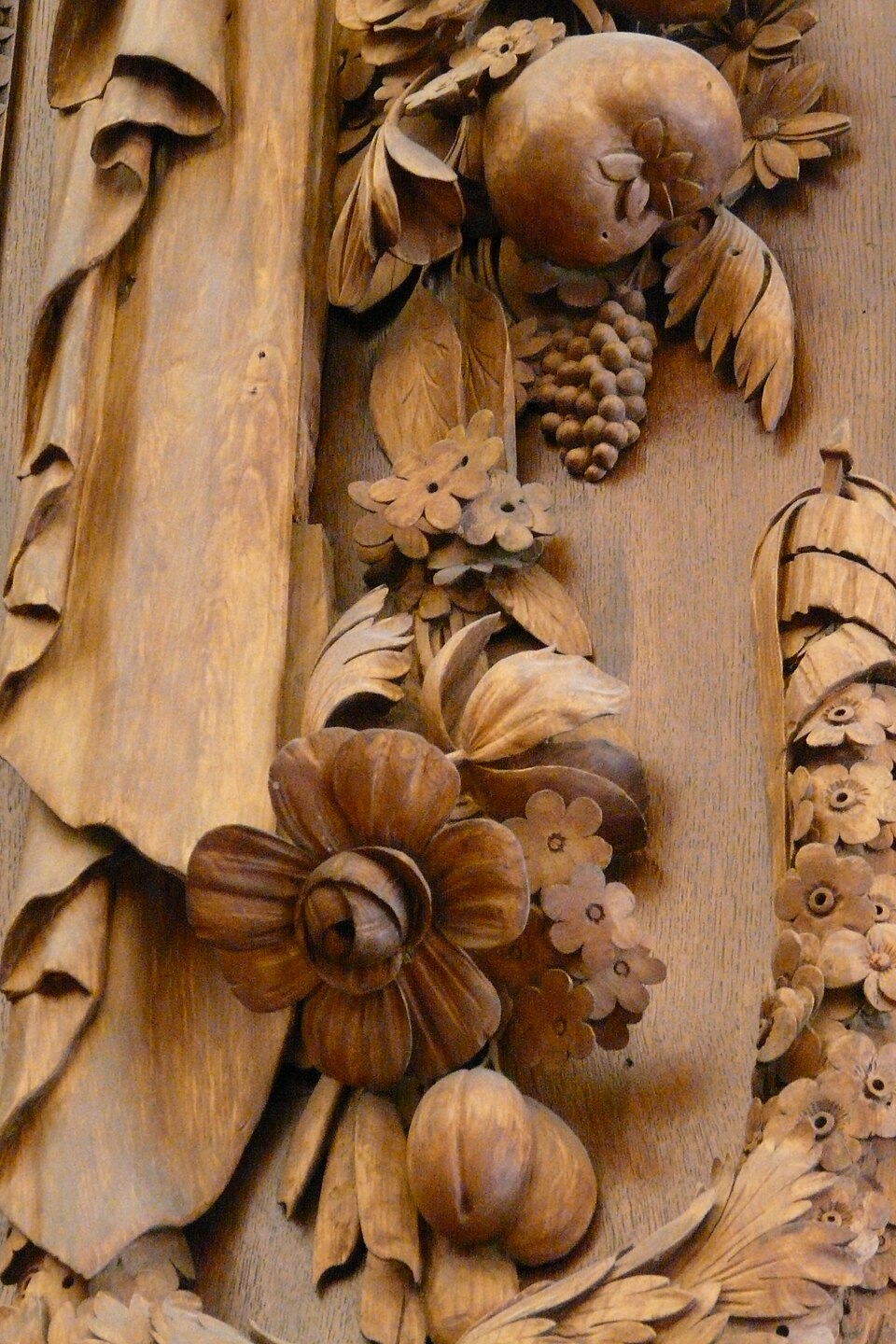
Grinling Gibbons (1648 -1721) was one of the most extraordinary woodcarvers of all time. His carvings were intricately three-dimensional and as a result he preferred to think of himself as a sculptor rather than a woodcarver. His work exhibited superb technical mastery and it was the realism and profusion of detail taken from nature that particularly marked his work.
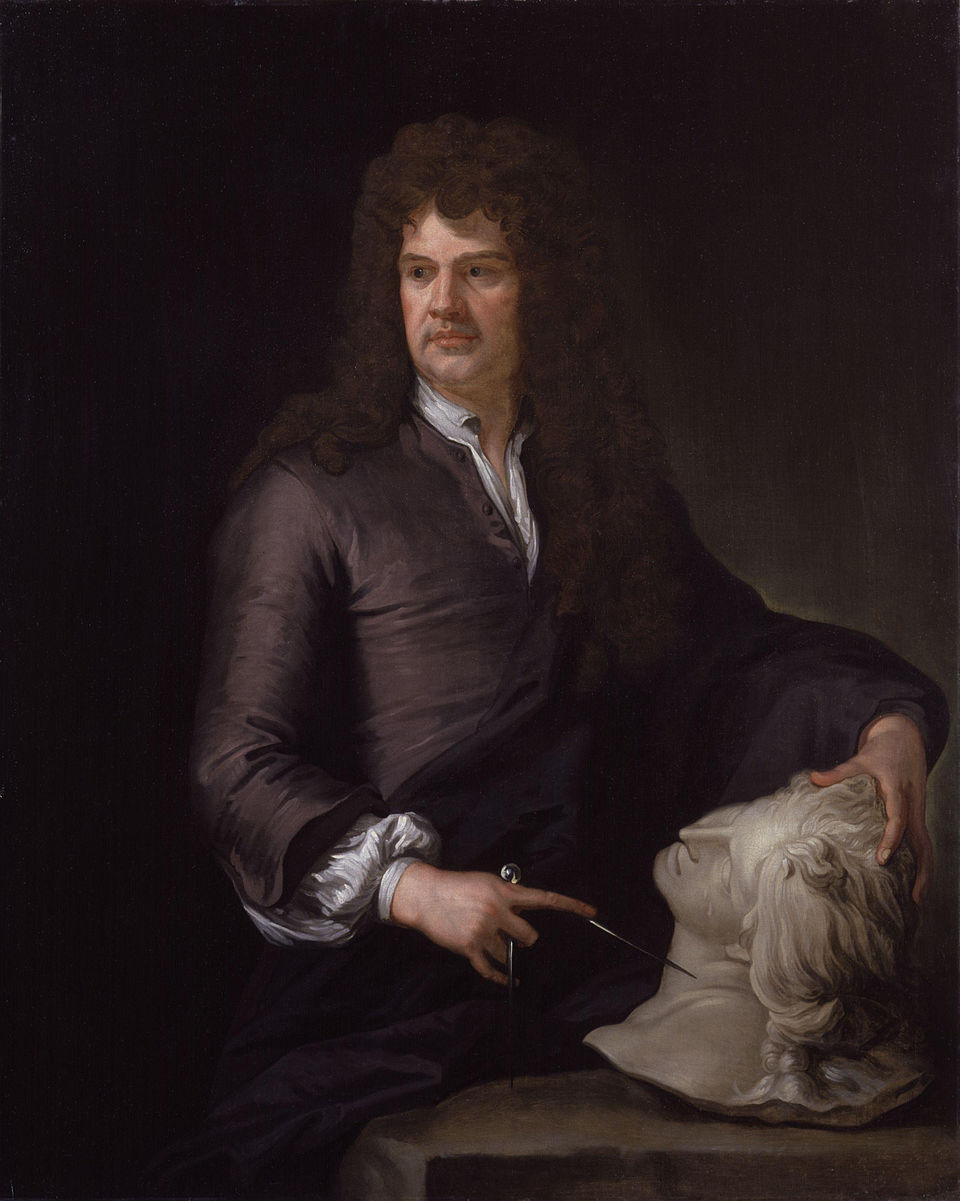
Anglo-Dutch by ancestry, Gibbons brought this new decorative style to England. His naturalistic, exuberant carvings of flowers, fruits, and foliage was often used in swags around mantelshelves. During his long career, Gibbons preferred material for fine carving was limewood (Tilia or linden) which is a uniform hardwood that is light and strong. Its cell walls are uniformly malleable which makes it easier to carve into draped folds. When freshly cut, limewood is very pale in colour but many of Gibbons’ surviving works are much darker, sometimes through design and sometimes just through age.
Gibbons was born in Rotterdam but having been introduced to Charles I, he soon after moved to England. By 1680, he was already known as the King's Carver and he had carried out work in St Paul's Cathedral, Windsor Castle and Hampton Court to name a few. Some spectacular work was commissioned by the Wyndham family at Petworth, a late 17th-century House 60 miles south east of Highclere. Henry Herbert married Elizabeth Wyndham and, inspired by both the interior and parkland at Petworth, set about improving Highclere in a similar vein. Whilst Highclere has since changed, it is clear that some of the original schemes have been kept as they were.
Gibbons was also a successful businessman and man about town, negotiating various introductions to secure his next new business. Horace Walpole, an arbiter of taste at that time, wrote: “There is no instance of a man before Gibbons who gave the wood the loose and airy lightness of flowers and chained together the various productions of the elements with the free disorder natural to each species.”
Sadly, we don’t have any Grinling Gibbons in the castle but every time I look at these picture frames, I am reminded of how much we often underestimate wood as an artist’s material. We eulogise about the majesty of tress outside and take doors, window frames and skirting boards for granted but I the hands of a master, it is indeed sculpture.
18 Comments
Lovely the pictures of wood carving and did you and lord Carnarvon wonderful weekend and lam fan of Downton Abbey and highcelere castle
I am a forever fan of Downton, and I do so appreciate all the notes and comments you add to the enjoyment
That's very kind Henry, thank you.
Truly Magnificent Work. Thank you for Sharing this with Us.
Rather hope so too - I wonder
Lady Carnarvon,
Your writing this morning reminds me of the beautiful carvings on the corner cupboard passed down to me by my great-grandparents who lived in the early 1800s. I have no idea of the woodcarver, except that he was very talented to be able to make the tiny cuts demanded of a determined person. I cherish the still-visible marks he made. Gibbons work is delightful, and the frames holding Sir Herbert’s portraits are so handsome. Thank you for another glimpse into the ancestry portrayed in your lovely home.
Martha G..
Brilliant Post as always.
I am a fun of Highclere Castle and Downton.
My 85 year old beautiful mother enjoys your Monday posts.
Lady Carnarvon, thank you for sharing this lovely history about your family and the beautiful art of wood carving.
Much appreciated!
Many thanks Daisy
I am a fan of beautifully carved frames. Thank you for sharing!
These are just beautiful. Than you for sharing !
I have read your blog for a long time now but I think this is my favorite one. The history of the 1st Earl . the amazing wood carving and also the timing of our history here in America. Thanks for all of the info you give us. Thanks, Sherrill Kearney
This was lovely. My late Father, who served in the
Navy and included oil paintings in his naval logs,
later learnt to do lino cuts on wood which looked
Like a combination of sculpting and painting.
The portrait o the first Earl is beautifully done as is the
Frame. What a treasure
I was fortunate to grow up in a house in California that had beautiful gumwood woodwork throughout the interior. Thank you for reminding me of the how much warmth and artistry woodworking adds to a home.
Beautiful pictures and the frames wonderful
Thank you
Dear Lady Carnarvon:
Thank you for this Monday's blog and the very nice pictures showing the woodworking within the Castle.
Perpetua Crawford
Leave a Comment
- Christmas
- Community
- Conservation & Wildlife
- Dogs & Horses
- Egypt & Tutankhamun
- Entertaining
- Farm
- Filming
- Gardens
- History & Heritage
- Daily Life
- Royalty
- Cooking
- Interiors
- Heroes
- Stories and Books
- Architecture
- Cars
- Conservation
- Downton Abbey
- Events
- Gardens & Landscape
- Highclere Castle Gin
- History
- Planes
- Restoration
- Stories & Books
- Uncategorized
- Visitors
- Wildlife
So very beautiful, I hope it's not a lost art.
I often wonder if we could create anything like this today
I recommend you visit Oberammergau, the German alpine village in Bavaria, to be assured wood carving is not a lost art. The town is full of shops displaying the work of many talented artists. The town even has a wood carving school!